 Coinomize
Mechanism
How Coinomize works under the hood.
A pooled Bitcoin mixer is a simple idea wrapped around a small number of careful design choices. Here is what Coinomize actually does between the moment your deposit confirms and the moment a different set of coins lands in your destination wallet.
Bitcoin's ledger is permanent and public. Every transfer reveals two addresses, an amount, and a timestamp — and clusters of related addresses form a graph that companies like Chainalysis and Elliptic mine for a living. Anyone who later receives coins you sent can trace those coins back to wherever you got them. A mixer interrupts that graph by replacing your outputs with unrelated ones from a pool.
Coinomize is one such mixer. The interesting part is how it does the replacement: not by "shuffling" coins through other users' addresses, but by paying you out of a pre-funded reserve while your deposit joins that reserve for someone else later. That distinction matters, and it's the reason the on-chain link between your old wallet and your new one truly disappears.
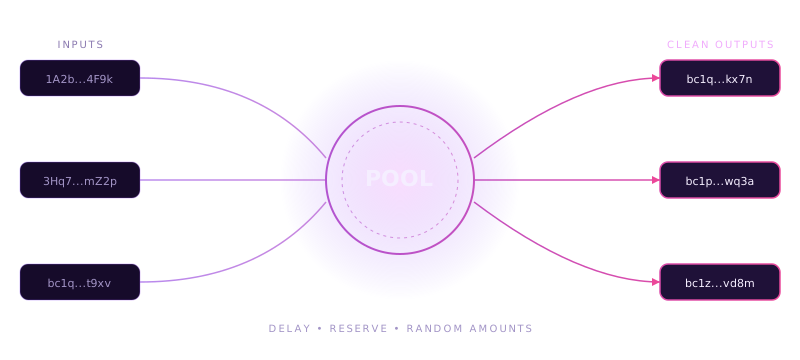
The reserve, not a shuffler
Most people imagine a mixer as a kind of high-speed swap — your coins go in, somebody else's coins come out, they're rotated through a few hops. Pooled mixers like Coinomize don't really work that way. The service keeps a Bitcoin reserve funded by older deposits and pays new users out of it. Your fresh deposit replenishes the reserve for the next user. The on-chain trail therefore points to coins that came from prior, unrelated activity — and the wallet you're trying to detach from has no link to the address you withdraw to.
The size of the reserve is what makes the link genuinely break. A reserve that holds the equivalent of thousands of small recent deposits has so many possible "source" candidates for any single withdrawal that probabilistic linking by chain-analysis tools collapses. This is also why running for years, as Coinomize has since 2019, matters more than fancy marketing — the pool has had time to accumulate variety.
Three randomisations that defeat correlation
Pool mixing alone isn't enough. Chain-analysis firms also look for patterns that re-link inputs to outputs even when the addresses change. Coinomize applies three randomisations to defeat the common ones:
1. Time
You set a delay between deposit and withdrawal, anywhere from instant to 96 hours. Different outputs in the same mix can use different delays. A withdrawal that arrives 38 hours after a deposit is much harder to pair with that deposit than one that arrives in the same block.
2. Amount
The exact value of each withdrawal is randomised inside the fee range you choose. If you deposit 0.5 BTC at a 0.5–3% fee, the mixer might send 0.491 or 0.487 or any value inside that band — never an exact, easily-matched figure.
3. Output addresses
You can split into up to 10 destination addresses. Each one gets a separate amount and a separate delay, so what was one deposit becomes ten independent withdrawals that do not look related to each other on the blockchain either.
Worth knowing
None of these features matter if the mixer keeps records. Coinomize lets you set the log retention up to 7 days down to 1 hour — after that, the server simply does not know which deposit you were. The security page covers what's retained in detail.
The letter of guarantee
Before you send anything to the deposit address, Coinomize gives you a plain-text document, signed with its published PGP key, that lists the deposit address, your output addresses, the chosen fee, and the chosen delay. You save this letter locally. If the service ever failed to deliver — say a withdrawal didn't arrive after the configured delay — that signed document is the public, verifiable proof of what the operator committed to.
The signature can be checked by anyone who has the Coinomize PGP key from the security page. The mixer cannot deny it issued the letter, and it cannot quietly change the terms after the fact. That's the practical meaning of "guarantee" in this context — not a refund, but a cryptographic record you control.
What this is not
Coinomize doesn't use zero-knowledge proofs, doesn't run a coordinated CoinJoin protocol, and doesn't issue a privacy token. It's a classic pooled custodial mixer with the operational guarantees a mature service needs to have to earn trust. If you want a non-custodial alternative, there are CoinJoin tools that work differently. Coinomize is a different trade-off: simpler, faster, and only as private as the size of its reserve and the soundness of its retention policy.